
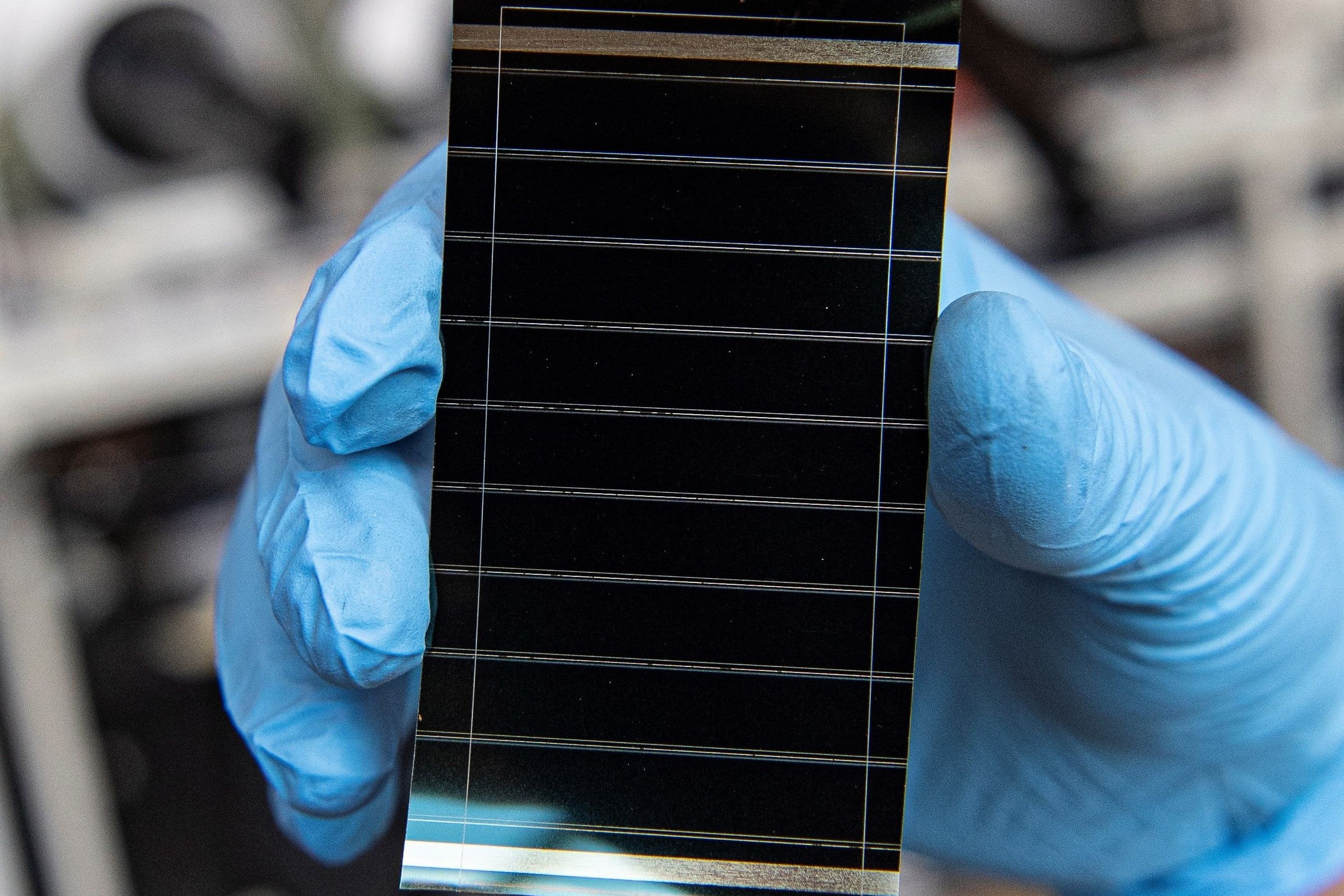
Key takeaways
- A tandem cell stacks a perovskite top cell on a silicon bottom cell, and a certified laboratory cell reached 35.5% efficiency in July 2026.
- Modules are further behind: Oxford PV said in January 2026 that its modules had 25% efficiency, and it plans mass production in 2027.
- Large-area manufacturing, yield, encapsulation, long-term stability and cost remain the hurdles between record cells and mass production.
Perovskite-silicon tandem cells are among the most closely watched developments in solar technology. By placing a perovskite cell on top of a silicon cell, manufacturers have produced devices with certified efficiencies above 33.7%, a threshold that pv magazine describes as the single-junction limit.
The practical question is how close these cells are to being sold on a large scale. The answer depends on whether one means a laboratory record, a pilot product or a factory-made panel. Those three stages are at very different points, and the figures below, drawn from company announcements, trade reporting and certification bodies from 2025 and 2026, show where each stands.
How a Tandem Cell Works
A tandem cell has two junctions. In the design used by LONGi, the Chinese manufacturer behind the record results, a perovskite top cell sits on a crystalline silicon bottom cell, according to pv magazine’s report on the company’s July 2026 record.
The practical consequence is wiring. Because each sub-cell produces a different output, some designs connect them separately. Pv magazine described one module-level design, from GCL, in which the perovskite sits above the silicon layer and each layer has its own connection box and output. A string of such modules needs two inverters, and GCL is working on connecting both layers to one inverter with two maximum power point trackers. Oxford PV and Huasun take a different route, adding the perovskite layers to a silicon heterojunction base cell, so the result is a single tandem cell that is then built into a module.
The perovskite part is not the expensive part. Oxford PV chief executive David Ward said the perovskite layer is not costly and that silicon accounts for the largest share of tandem cell cost, pv magazine reported in January. His company makes the top cell and plans to buy bottom silicon cells from outside suppliers.
Key Figures
Highest reported certified tandem cell efficiency: 35.5% (LONGi, July 2026, certified by ESTI). Previous record: 34.85% (April 2025, NREL). Tandem module output: 907 W at 29.2% full-area efficiency (Trinasolar, June 2026, company-reported). Oxford PV module efficiency: 25% as of January 2026, with mass production planned for 2027.
The Efficiency Records
LONGi’s certified tandem results have climbed in steps: 31.8% in 2023, 33.9% later that year, 34.6% in 2024 and 34.85% in April 2025, certified by the US National Renewable Energy Laboratory (NREL). Pv magazine’s April 2025 report called 34.85% the first reported certified efficiency above the 33.7% Shockley-Queisser limit, which it describes as the single-junction limit. Its July 2026 report also lists the 33.9% result from 2023, which would have passed that limit earlier, so the two pv magazine reports do not agree on which result came first. The 34.85% cell reached an open-circuit voltage of 1.97 volts and a fill factor of 83.0%.
On 14 July 2026, at a conference at Shanghai Jiao Tong University, LONGi announced 35.5%, certified by the European Solar Test Installation (ESTI), part of the European Commission’s Joint Research Centre in Italy. The company did not disclose the active area or detailed electrical characteristics, and it has not given a timeline for commercial production of the new device.
Size matters when reading these numbers. In June 2025 LONGi reported 33% for a 260.9 square centimetre two-terminal tandem cell certified by NREL. Pv magazine says that result is not directly comparable with the 35.5% figure because larger areas bring added challenges. A record on a small laboratory device and efficiency across a full-size panel are different measurements.
What Is Actually Being Built
Oxford PV, a company that began perovskite tandem work in 2014, runs a pilot plant in Brandenburg an der Havel in eastern Germany. In June 2024 it unveiled a tandem module with 26.9% efficiency, and later that year it announced the commercial launch of its modules in the United States, pv magazine reported. As of January 2026, its current module efficiency was 25%.
The company’s roadmap, as described in January 2026, calls for 26% efficiency with a 15-year lifetime in 2026, 27% with a 20-year lifetime in 2027 and 30% with a 30-year lifetime in 2030. It targets mass production in 2027, an earlier date than the 2028 figure that pv magazine first published and later corrected. Oxford PV is evaluating sites in the Middle East, the United States and Europe, and aims to start manufacturing at a new site in late 2027 or early 2028. For China, it signed an exclusive licensing agreement with Trina Solar in April, so it is unlikely to manufacture there itself.
Trinasolar announced on 9 June 2026 a perovskite and crystalline silicon tandem module with a peak output of 907 watts and a full-area efficiency of 29.2%, verified by the testing body TÜV SÜD. The company says module power rose from 808 W to 907 W in slightly more than a year, and that the module uses its 210 mm tandem cell platform and meets mainstream industry specifications. These are company-reported figures, and the record claim is Trinasolar’s own.
A record on a small laboratory device and efficiency across a full-size panel are different measurements.
What Still Stands in the Way
Pv magazine’s account of the LONGi result lists the remaining hurdles: large-area deposition of the perovskite layer, manufacturing yield, encapsulation, long-term stability and cost. It stresses that the 35.5% device is a certified laboratory cell, not a commercial module, and that LONGi said in June that it had no active mass-production plan for crystalline silicon-perovskite tandem cells. The technology remains at the research stage.
Lifetime is the clearest commercial test. Ward said a 20-year lifetime will be critical for commercialising tandem products, and that developers focus more on the levelised cost of energy than on a 40-year life. That explains why Oxford PV’s roadmap pairs each efficiency step with a longer lifetime target. In May 2025, pv magazine reported a 10-year warranty for Oxford PV’s second-generation modules and a target of 20 years for the third.
Oxford PV is also still scaling up. Its Brandenburg plant makes pilot products for the utility-scale and the commercial and industrial markets, plus specialty products for non-terrestrial uses, pv magazine reported.
What to Watch in the Coming Year
Three milestones will show whether tandems are moving from announcements to supply. The first is whether Oxford PV starts mass production in 2027 as planned and where it chooses to build. The second is whether larger devices, such as the 210 mm cell platform Trinasolar uses, keep closing the gap with small laboratory cells. The third is whether any manufacturer publishes independent long-term outdoor test data.
Other makers have their own schedules. Pv magazine reported that GCL expects its tandem module to reach 26.36% efficiency at a size of two metres by one metre, with a market launch planned for 2026, and that Huasun plans an 800 W heterojunction tandem module from 2026 with a long-term goal of cell efficiency above 30% in mass production. Those are plans, not deliveries, and readers should check them against the companies’ latest announcements.
Sources
- Longi sets new world record with 35.5% efficient perovskite-silicon tandem cell, pv magazine
- Longi achieves 34.85% efficiency for two-terminal tandem perovskite solar cell, pv magazine
- Oxford PV targets 20-year lifetime for perovskite-silicon tandem modules by 2028, pv magazine
- Tandem cell or tandem module?, pv magazine
- Trinasolar achieves 907W power output for its tandem modules, setting a new world record, Trinasolar