Key takeaways
- NASA astronaut Anil Menon and Canadian Space Agency astronaut Josh Kutryk were scheduled to install the seventh International Space Station Roll-Out Solar Array (iROSA) in the 2A position on October 29.
- The October 29 walk was scheduled as the first spacewalk by a Canadian astronaut in seven years, and the first for Kutryk.
- Once all eight iROSAs are installed, the station’s power supply is expected to rise from 160 kilowatts to about 215 kilowatts, which Space.com describes as a boost of roughly 30%.
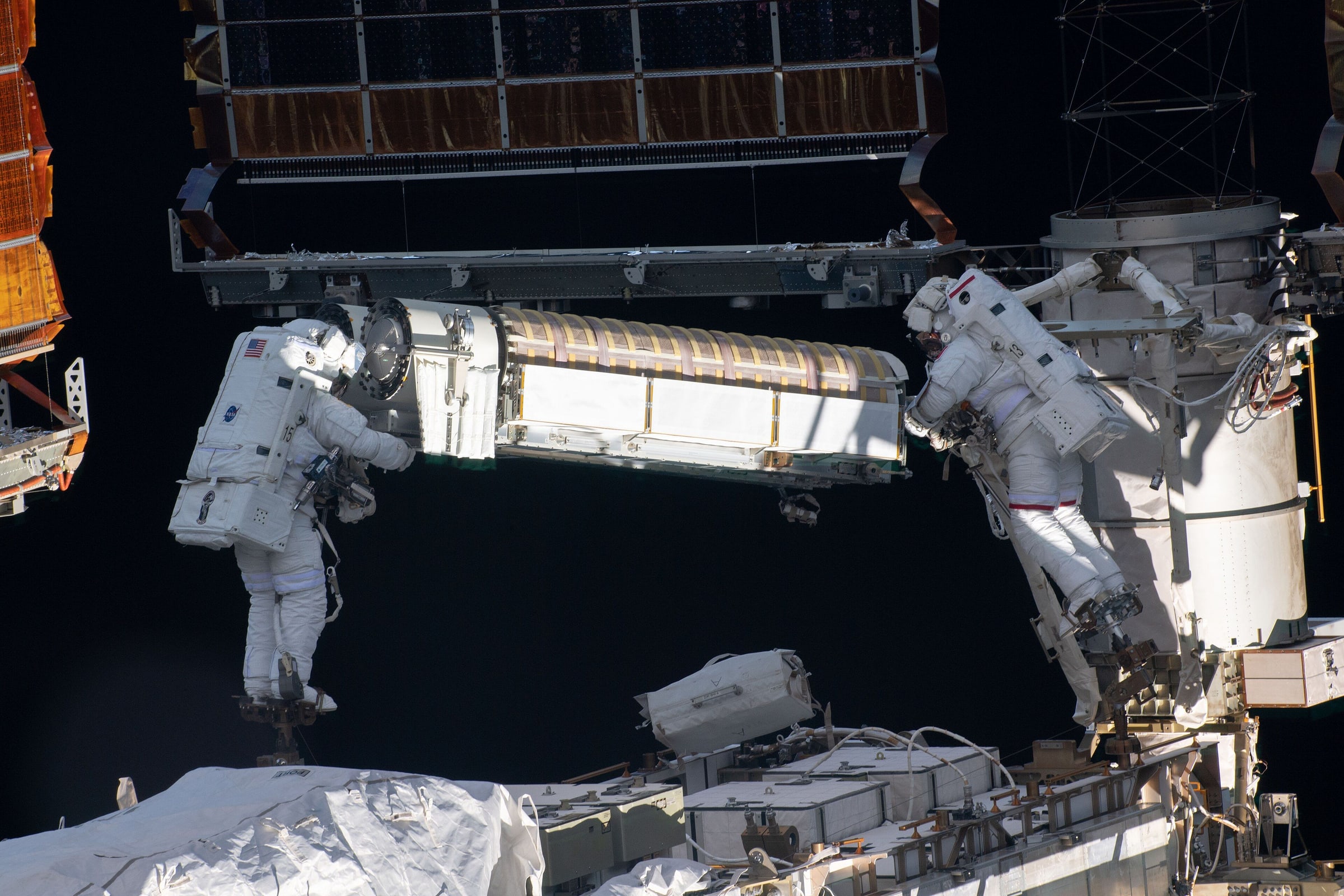
Two astronauts were set to step outside the International Space Station on October 29, 2026, to install a new roll-out solar array, the seventh in a series called iROSA. NASA was scheduled to stream the spacewalk live, beginning at 6:30 a.m. EDT, with the walk set to start at 8 a.m. EDT and last roughly 6 hours and 45 minutes.
For Kutryk, the walk was his first spacewalk, and Canada’s first in seven years. The CSA’s last spacewalk was during the agency’s previous mission seven years ago, which involved astronaut David Saint-Jacques.
What iROSA Is and Why the ISS Needs It
The original arrays have deteriorated after more than two decades of exposure to the space environment. The iROSAs lie on top of the existing, decades-old arrays on the station. Starting in 2021, NASA began the process of upgrading the station’s power systems, and the first iROSA rolled out that year.
An iROSA is flexible and launches rolled up on a spool, taking up only a quarter of the space of a rigid array. Once deployed, it unspools on its own, with no motor or gearbox. Each array is about 10 feet (3 meters) long when folded up and weighs 750 pounds (340 kilograms), according to Garrett Hehn, NASA’s spacewalk flight director. Once installed, the array goes from about 10 feet long to around 20 feet (6 m) long, and Hehn said the rollout takes about 10 minutes on the day of the spacewalk.
Space.com reports that once all eight iROSAs are installed and running, the station will see its power supply rise from 160 kilowatts to about 215 kilowatts, a boost of roughly 30%.
The iROSA Solar Upgrade: By the Numbers
The first iROSA rolled out in 2021. Each array is about 10 feet (3 meters) long when folded up and weighs 750 pounds (340 kilograms). Once all eight are installed, power supply is expected to rise from 160 kilowatts to about 215 kilowatts, a boost Space.com puts at roughly 30%. The CSA’s previous spacewalk was on April 8, 2019, with astronaut David Saint-Jacques.
Menon and Kutryk: Who Was Scheduled to Walk
Anil Menon was born in Minneapolis to an Indian father with roots in Kerala and a Ukrainian mother. He is a physician and mechanical engineer selected by NASA in 2021, and he reached the International Space Station aboard the Soyuz MS-29 spacecraft on July 14. For the October 29 walk, Menon was to attach himself to the robotic arm, retrieve the roll-out solar array, and ride Canadarm2 to the installation worksite.
Josh Kutryk is a colonel in the Royal Canadian Air Force. He launched on Oct. 1 aboard a SpaceX Crew Dragon with three other astronauts. His flight was delayed two years, from 2024 to 2026, because he was originally assigned to fly up on Boeing’s Starliner capsule.
A second spacewalk, scheduled for November 5, is set to install the eighth and final iROSA in the 3B location.
For Kutryk, the walk was his first spacewalk, and Canada’s first in seven years.
Canada’s Role in the Station
Canadarm2, the station’s robotic arm, is helping with the walk. From inside the station, NASA astronauts Luke Delaney and Jessica Watkins will carefully move Canadarm2 to put Menon and the array at the installation site. CSA astronaut Jenni Gibbons is the capsule communicator for both spacewalks.
The CSA has a 2.3% contribution to the ISS, usually working out to a flight every five or six years. Canada is therefore using the new CSA mission as a catalyst, and in recent weeks it announced several government and industry commitments to keep the momentum going after Kutryk returns next spring.
Sources
- ISS astronaut will conduct Canada’s 1st spacewalk in 7 years on Oct. 29, Space.com
- Canadian astronaut Joshua Kutryk to conduct his first spacewalk Thursday, The Weather Network
- NASA/CSA Spacewalk at ISS (1 of 2), Oct. 29, 2026, SpacePolicyOnline
- Anil Menon Undertakes First Spacewalk, Deccan Chronicle
- Astronaut Anil Menon set to undertake maiden spacewalk next week, The Print