Key takeaways
- Hera reached the Didymos binary asteroid system in early November 2026, about four years after NASA’s DART probe struck the smaller body, Dimorphos.
- Its first images show boulders, smoother patches and an equatorial ridge on Didymos, along with a side of Didymos that DART’s camera could not observe shortly before impact.
- Detailed images are due on 25 November, and Hera will study the effects of the DART impact for at least six months, while two shoebox-sized CubeSats are deployed for a closer look.
The European Space Agency’s Hera spacecraft has arrived at the binary asteroid system Didymos and Dimorphos and returned its first images, the German Aerospace Center (DLR) said in a release updated on 17 November. Built by OHB in Bremen, the probe reached its target in early November 2026 after more than two years in transit.
The target is a pair of asteroids whose orbit was changed on purpose. In September 2022 NASA’s roughly 500-kilogram DART spacecraft struck Dimorphos at about 6.1 kilometres per second and shortened its orbital period around Didymos by about 33 minutes, a much greater change than expected, according to DLR. Hera is the European component of the Asteroid Impact and Deflection Assessment (AIDA) project, a joint undertaking of ESA and NASA. Among other things, it is to investigate how that collision affected Dimorphos and the surface properties of Didymos.
What the First Images Show
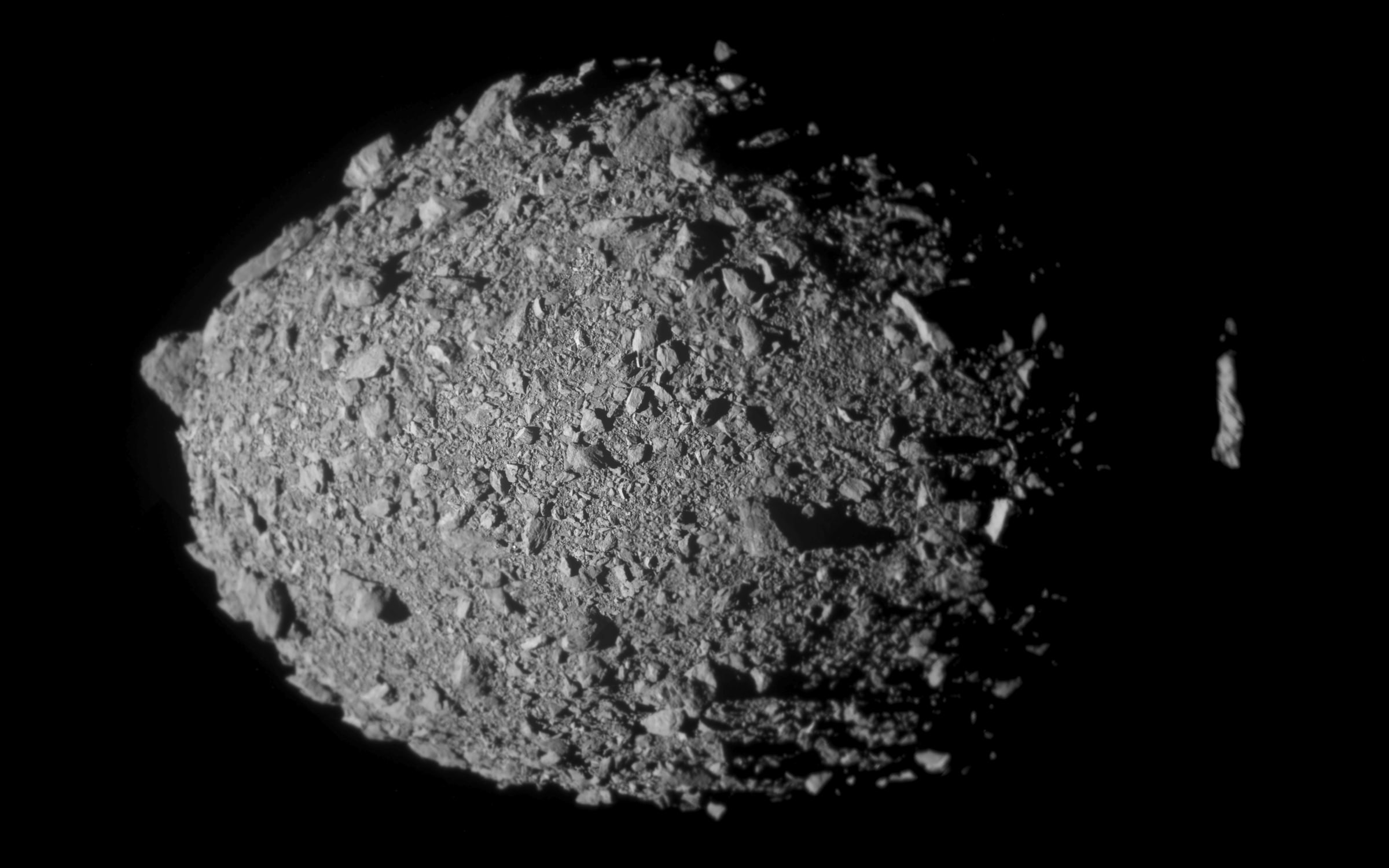
DLR, the scientific lead for the Asteroid Framing Camera, released two early frames. The first, taken from 60 kilometres away, shows Dimorphos mostly in shadow and Didymos clearly visible, with a side that the camera on DART was unable to observe shortly before impact. The second, from 56 kilometres, shows one side of Didymos with the tip of Dimorphos near its north pole, large boulders, smoother areas and a sharp ridge running along the equator.
An update dated 17 November added three views of Didymos taken from 28.5 kilometres in visible light, thermal infrared and multispectral imaging. The release describes boulders, craters and grooves or ridges, and says researchers want to know whether some of these features formed in the DART impact, since ejected material may have reached Didymos. It also offers one possible explanation for the ridge: fast rotation may push surface material toward the equator, which could also help explain why Dimorphos exists at all.
A JAXA operations entry on the Hera project site, posted on 6 November and updated on 18 November, says Hera arrived at the binary asteroid system at the beginning of November.
The Didymos System at a Glance
Didymos is about 780 metres wide and rotates about once every 2.2 hours. Dimorphos is about 151 metres wide and orbits at barely more than one kilometre. NASA’s DART struck Dimorphos at about 6.1 kilometres per second in September 2022 and shortened its orbital period by about 33 minutes. Hera launched on 7 October 2024 and will study the effects of the impact for at least six months.
A Small, Dark Target
The two bodies are modest in size. DLR gives Didymos a diameter of about 780 metres and a rotation period of about 2.2 hours, while Dimorphos is about 151 metres across and orbits Didymos at barely more than one kilometre.
Finding them was part of the challenge. ESA said in March that both objects are small and dark, so Hera must actively search for them and keep them centred in its field of view. Rehearsals began in 2025, when the spacecraft observed two main-belt asteroids, Otero and Kellyday, from about 3 million kilometres away in the case of Otero. ESA’s flight dynamics and flight control teams tracked Otero for three hours, taking one image every six minutes, and then pointed the camera at Kellyday, which proved roughly 40 times fainter. The exercise was not meant mainly for science. It was meant to test the procedures Hera would need when it first sighted its real target. ESA flight dynamics engineer Giacomo Moresco said at the time that Didymos would also be "a tiny, faint point of light among the stars" when it first appeared.
The Braking Campaign
Hera launched on 7 October 2024 and flew past Mars in March 2025, using the planet’s gravity to adjust its path. In February and March 2026 it carried out a deep-space manoeuvre that ESA says burned 123 kilograms of hydrazine fuel and changed the spacecraft’s velocity by 367 metres per second. ESA’s Francesco Castellini called it the mission’s largest manoeuvre in terms of fuel consumption.
The final approach began in October with a series of braking burns. According to JAXA’s operations log, Hera captured images of the pair with the Asteroid Framing Camera from 1,280 kilometres on 18 October (Japan time), carried out its second braking manoeuvre on 22 October while approaching at a relative speed of 20 metres per second, and planned trim burns for 25, 28 and 31 October. Hera was expected to arrive 20 to 30 kilometres from the system on 4 November Japan time. ESA had said the approach phase would last about three weeks.
Operating a spacecraft so far away is slow work. Anna Schiavo of the Hera flight control team described a twenty-minute time delay between speaking and hearing a response, and said that sending a software update to the probe takes about three hours for the first step alone. The updates ESA prepared before the arrival included new software for the laser altimeter and for the monitoring camera that will watch the release of the two CubeSats.
Among other things, it is to investigate how that collision affected Dimorphos and the surface properties of Didymos.
The Instruments and Who Built Them
Hera carries two identical Asteroid Framing Cameras, built by Jena-Optronik in Germany, to map surfaces and build three-dimensional models. It also carries a Planetary Altimeter, a laser rangefinder based on a Jenoptik diode laser. DLR’s Institute of Space Research holds scientific responsibility for both instruments and is directly responsible for the scientific analysis of shape and morphology.
The cameras are built with redundancy, DLR said. Germany provides 37.5 per cent of the mission’s funding, coordinated by the German Space Agency at DLR, and other German suppliers include HPS, which made the carbon-fibre antenna, and Dresden University of Technology, which helped develop the radar experiment on the Juventas CubeSat.
What Comes Next
The next public milestone is 25 November, when detailed images of Didymos and Dimorphos are due. After that, DLR says, Hera will spend at least six months studying the effects of the impact, including a close-range crash site investigation of Dimorphos using several instruments.
Two shoebox-sized CubeSats will be deployed for a closer look, and DLR says a landing attempt is possible. Juventas carries a radar experiment developed with Dresden University of Technology. Researchers hope this information will yield important insights for planetary defence from asteroids.
Sources
- Hera spots its target: a first glimpse into the study of the Didymos binary asteroid system, German Aerospace Center (DLR)
- Hera operations updates, JAXA Hera project
- Hera on course for asteroid rendezvous, European Space Agency
- First asteroid sightings push Hera’s camera to the limit, European Space Agency